
Last week we received our biggest container yet - a 40 foot - directly from the Daterra farm in Brazil. The container was swiftly emptied and the coffee is now in our storage space. This week we're roasting it and Tuesday afternoon it will be on the shelves.
Four years ago Klaus and I got a dream fulfilled when we, in search for coffee to be used at WBC, tasted the Sweet Collection at the Daterra farm. Ever since we have enjoyed the sweetness and creamy body of this coffee!
Back in March 2009 I went to Brazil again and I of course was very happy to be able to visit Daterra again. Andreza Mazarao followed me to the farm and was the same wonderful host as I remember from the last time!

Since we had recently gotten a new lot of Daterra Sweet Collection it was interesting to try to track this back. And here the People at Daterra showed one of the reasons why they consistently produce such high quality: It took them less than two minutes to track back and find the specific lot.

It turned out that the particular lot we got last year was from their Fazenda Tabuoes Lot no. 22 and this was a lot of pure Bourbon trees. This to me shows a systematic approach which - along with the craftsmanship and continued drive towards higher quality of all the people at the farm - is very convincing. Beside the wonderful hospitality I really enjoyed and learned a lot from the talks with Carlinhos in the cupping lab and the agronomist Gustavo in the field.
Gustavo
To me Carlinhos is an extremely skilled cupper and we are very grateful for his work. On Fazenda Tabuoes his counterpart is Renato who is the cupper there. Since our lot is from this Fazenda he obviously has been more involved in the production of our lot of Sweet Collection and we are therefore also very grateful to him.
Carlinhos
This is just to mention a few of the people who work hard to produce the fantastic coffee and of course our thanks goes to all the people at Daterra!
A topic that has had my interest for a long time as an espresso enthusiast is the definition of the Cerrado region. We had some very interesting talks about this and especially Gustavo shed some lights on this for me. As I understand it now the Cerrado region is mainly lying within the State of Minas Gerais but partly also in Mato Grosso do Sul and Goias. The region is defined by certain geographical features. The Climate is rather dry and the soil is red with approx. 40% clay which makes the soil quite good for retaining water. But since the climate is rather dry the vegetation is adapted to low precipitation rates.

Typically for the region is the Lobeira tree (Lobo = wolf. The name was given because the typical wolf of cerrado "Lobo-guará" eat the tree fruit). It has very thick leaves which is good for storing water. It has a bark similar of cork which gives the tree protecion against some of the naturally occuring fires in the dry enviroment.
The Lobeira tree

It is believed that the geographical conditions is stressing the coffee tree a bit. Not stressing the tree too much but enough so that it develops a coffee with good body. At Daterra some of the coffees are irrigated and others not. Carlinhos told me that the irrigated coffees tended to be less dense than the coffees that came from trees that was not irrigated. If this seemingly relation between supply of water and the density of the bean also reflects in the body it would be intesting to find investigate more. But the dry conditions in Cerrado and creamy body that coffees from this region sometimes has might indicate some relation like this.
Peter at Lot 22 with Bourbon trees

All in all the visit at Daterra answered many questions for me and at the same time new questions came along. As if it wasn’t enough to be with people this knowledgable about farming I had the pleasure to be accompanied by distributor of La Marzocco and Mahlkönig in Brazil, Paul Germscheid, whose technical knowledge of these machines is just flowing from him in a continuous stream.
Thanks a lot to everyone for making this trip wonderful!
Peter
Monday, January 18, 2010
New Crop Daterra Sweet Collection


Friday, January 8, 2010
La Esmeralda - we eat our own words!
When we first presented the coffee from Hacienda La Esmeralda, we said that we would not serve it as any form of espresso drink! Well, hmm, we couldn't leave it there. We have decided to put a small batch in the grinder and serve this as espresso, in cappuccinos and americanos, as long as the batch lasts (through the weekend?) !
The espressobrewing is really bringing the elegant aromas of this coffee forward. It might even be the brewing method where we find that the aromas of abricot, bergamot and the heather honey is the most intense and maybe a hint of eukalyptus also sneaks through. Even in the cappuccinos there is no doubt on which coffee it is.
If you are in the neighborhood during the weekend drop by and ask to get yur coffee with La Esmeralda.
Thursday, December 17, 2009
Christmas time

Just a brief note on our opening hours around Christmas and New Year.
The Roastery & Office will be closed from Wednesday 23rd of December untill Sunday 3rd of January both days included. This also means that the webshop will be closed in the same period.
Our Coffee Shop will have the following opening hours:
Wednesday 23rd 7.30 - 17
Thursday 24th Closed
Friday 25th Closed
Saturday 26th Closed
Sunday 27th 10 - 18
Monday 28th 10 - 19
Tuesday 29th 10 - 19
Wednesday 30th 10 - 19
Thursday 31st 10 - 16
Closed Friday 1st of January
From Saturday 2nd of January 2010 the opening hours are normal.
Edit: Very last webshop orders before Christmas will be sent out tomorrow with a special delivery. Orders in before noon tomorrow should have a good chance of making it before Christmas (in Denmark only).
Sunday, December 13, 2009
Gløgg Recipe 2009
We interrupt all the seriousness of coffee related discussions about quality and Direct Trade and whatnot with a little update on 'that other warm favourite drink of ours': Gløgg!
Some of the readers are probably familiar with my old recipe for Gløgg which lately has been makings its rounds on Twitter. But that was 2007 and since then I've been trying to improve on it and make the recipe a little more exact.
You can find many recipes for apple or white wine gløgg online, but I am all in favour of red wine gløgg personally. I do love the occasional apple gløgg or one with white wine and white port, but not when I make it myself.
So, here is this years version of traditional Danish Christmas Gløgg.
To explain, you must first make an extract of all the spices, which you have to make at least the day before - but this can also be made up to a couple of weeks before. If you make a big portion you’ll have for several days of gløgg-happiness!
Extract
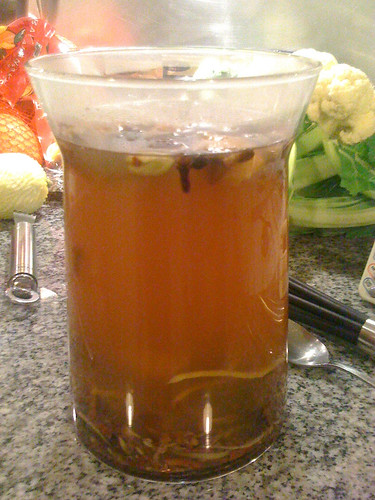
8 whole Cardemom seeds
8 whole Star Anise
5 Cinnamon sticks (just 3 if they are really long)
10-15 Cloves
15-20 Pebbercorns
1 Bay Leaf
1 cm³ Ginger (fresh or a little more dried)
1-2 Lemons (just the peel)
1 Orange (peel and juice)
½ Vanilla pod (or just ¼ if it’s a good quality)
1 dl. Dark Brown Sugar (the sticky Danish Brun Farin is the best)
Optional:
Allspice
Juniper
Nutmeg
Crush all the spices slightly and boil them with the lemon and orange peel, orange juice, vanilla and sugar. Let it simmer with the lid on for half an hour. Put aside and cool down and keep refridgerated. Sieve just before use.
The day before you’re going to make the Gløgg cover about 2 dl. of raisins with dark rum.
You’ll also need to scald the same amount of almonds, remove the peel and chop them in small sticks, but this can be done on the same day of making the gløgg.
Gløgg
Use approx:
0,5 l. of the extract to
0,75 l. of red wine (one bottle).
1-2 dl. Port Wine
Add the almonds, raisins and rum and heat up gently.
½ dl. Blackcurrant concentrated juice.
½ dl Cointreau or Grand Marnier
Some snaps, cognac or more dark rum if you feel up for it.
Sweeten to taste with more Dark Brown sugar, muscovado sugar, blackcurrant juice or honey. The balance is important. It should be sweet but not too sweet.
The Gløgg must never boil! But it should be really warm when it’s served and you should feel a good buzz from just inhaling the scent :-)