
One of the most important and basic elements of our coffee shops is that the coffee is the focal point. We don't serve avocado sandwiches, hot chilli for cold winter days or even little squares of chocolate on the saucer only croissants in the morning and small, delicate pastries like a granola bar - nothing that has enough potency to take the focus away from the the cup. We want to share unique coffee experiences without too many distractions.
A lot of good restaurants have begun to work on their coffee profile to make it as much a part of the experience as the food and wine. This is a great development that gives us, as a specialty coffee community, a much broader audience to share great coffee experiences with. It also brings coffee into the light, makes it more than just that black stuff we drink when cake is on the table, which gave rise to the idea we are now testing at our coffee shop on Godthåbsvej. We wanted to look into serving more food with the coffees without turning into a cafe.
The idea was to keep it as simple as possible. Three small dishes, each paired with a specific coffee as a combined experience. The dishes change along with our coffee menu, so new flavour combinations can be tested.
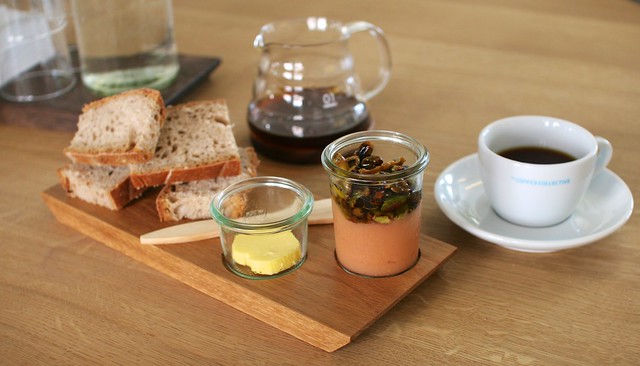
Every dish consists of a couple of slices of sour doe bread and some butter served with different jams and purées consisting of a single ingredient pressure cooked with just a little bit of sugar, to preserve it, and maybe a small squeeze of lemon. This is topped with some kind of ingredient, could be a type of nut, to give it some texture and flavour balance. Other sides could be different cured meats or cheese all depending on which coffee we want pair it with.
This is the menu as it looks at the moment:
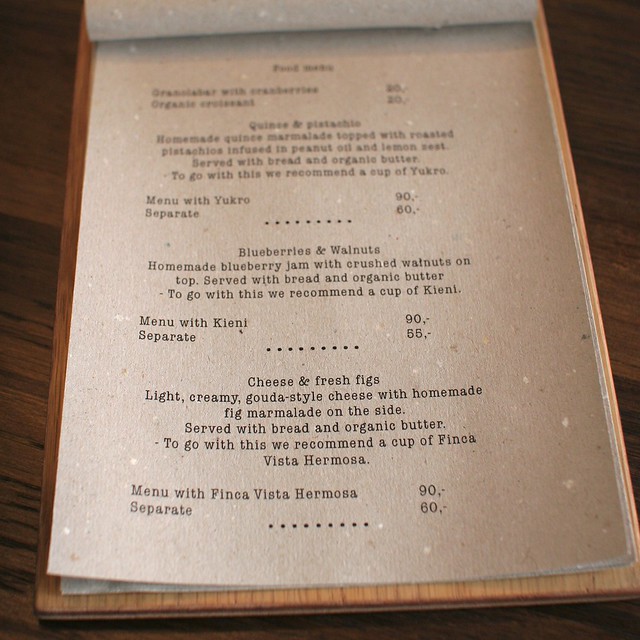
Very simple and small. It's not a full meal, more a supplement to highlight the flavours in the cup - nothing more, nothing less.
If you'd like to read more (in Danish) the news paper Politiken did a great article on food and coffee recently: http://politiken.dk/ibyen/nyheder/cafeer/ECE2002967/tendens-nu-skal-vi-have-mad-til-kaffen/
Monday, July 8, 2013
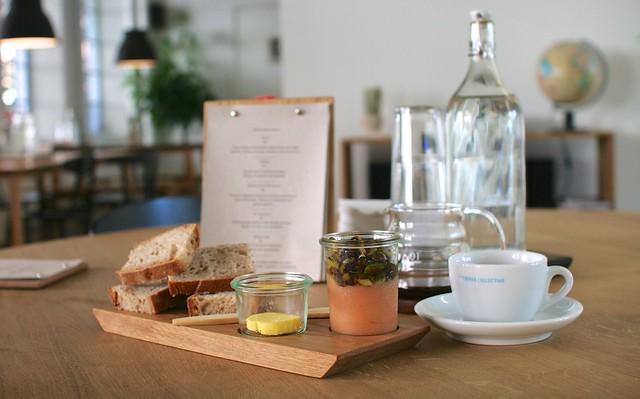
Food and coffee at Godthåbsvej

Friday, June 28, 2013
Guatemala 2013 pt 2 - Finca Vista Hermosa
Today we're launching the fresh crop Guatemalan coffees from
Finca Vista Hermosa and El Diamante. Both will be available in our webshop
and our coffee shops. In March our director Peter Dupont and bar
manager and 2013 Danish Barista Champion Rasmus Gamrath visited the
farms in the region of Huehuetanango. Here are their reports from the
trip in two parts. Click here for part one.
In March, I (Rasmus Gamrath) was lucky to get to go to Origin for the
first time. Its something I've been dreaming about doing for a long
time. I have been excited to get to smell, touch and see everything that
goes on at the farm. Getting to go to Huehuetenango was just an extra
bonus since we are buying from two different farms in the area. Peter
has written about our visit to El Diamante, so I will focus on our visit
to Finca Vista Hermosa.
The first thing that stroke me on the
drive up to Finca Vista Hermosa was all the people in the area, that are
involved in producing coffee. It really confirmed the amount of labour
going into producing coffee. It’s something we are all aware of in our
daily work in the bar, but it somehow still managed to surprise me. And
it really showed me how much respect we should have for the effort
people working at the farms put into producing quality coffee.
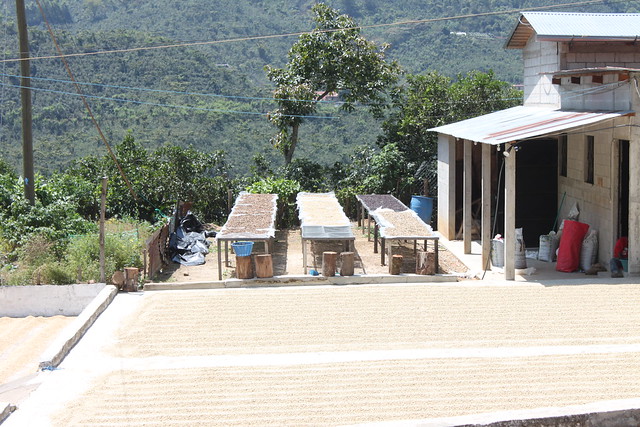
Drying coffee at FVH
We
were staying at the farm for two days, so we got to experience first
hand what goes on at farm. Peter had arranged for us to come with Diego
one of the farm workers and try to pick berries for a few hours. It was
interesting to see how difficult it actually is to only pick the fully
ripe cherries, and how long time it takes. Due to the slow progress we
didn’t get to pick a lot, but at least the other pickers got some good
laughs looking at our rookie picking style.
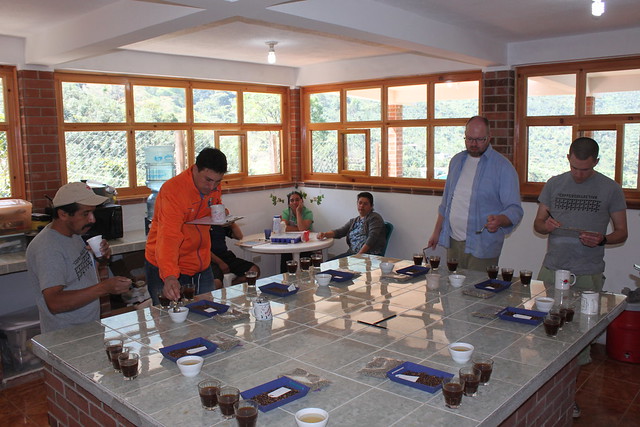
Later in the day we
cupped 9 different lots from this years harvest at Finca Vista Hermosa.
It was a good experience to get to cup together with Edwin and Eliseo
(the farm manager at Finca Vista Hermosa) and hear their descriptions of
their coffee.
The next day Edwin showed us around on Finca
Vista Hermosa. We talked about the Roya (leaf rust) that is so
challenging for a lot of farmers at the moment. Luckily it’s not
something they have had problems with at Finca Vista Hermosa. We also
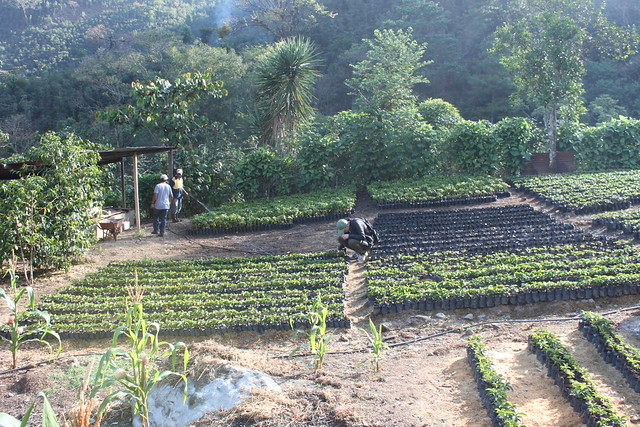
had a look at the nursery were they grow plants to plant on new lots.
They normally grow all new plants themselves, unless they need new
varieties. The way they reproduce plants is by taking a coffee bean
still in its mucilage and leaving it in a sand-like soil. At a point the
bean will sprout and is then put in a plastic back with earth and is
watered intensely. After about two years the plant is ready to be
planted outside the nursery.
Nursery at FVH
When walking around on the farm
Edwin told us about different projects they are doing. They are looking
at different drying methods, at the moment they are drying on patios but
for this year they have done some tests on raised beds. They are also
doing tests on different pruning methods. It was all very interesting to
see.
-Rasmus Gamrath

Wednesday, June 26, 2013
FOB Price on Label
We are now launching an idea we have had since we started The Coffee Collective. We feel that its time to make it transparent for the consumers what is actually paid for the green beans.
When we started buying green beans in The Coffee Collective in 2007 we had the same idea, but we understood from some of the producers we were buying from that they would feel a bit uncomfortable if we revealed what we were paying them. Therefore we didn't do it back then.
Now a lot of things has happened since 2007.
Firstly, back then it was in the aftermath of the coffee crisis, when the market price was extremely low in the period from 1999 to 2005. In 2007 prices had increased since 2005. The market price is now falling again to levels that seems unsustainable. At the same time a rust outbreak is creating huge problems in many producing countries (mainly in Latin America) without the market reacting.
Secondly, within the specialty coffee industry other roasters and traders are now revealing their green prices on their websites, so we do not feel that we are breaking a bond of trust between us and the producers.
Thirdly, on the suggestion of one of the producers we work with, we have added to the transparent price how long we have been working together as a way of showing our relationship.
We believe that it is important to be transparent towards the consumers. We know from our dialogue with our costumers regarding Direct Trade that a lot of people actually are interested in knowing that when they pay a high price for a bag of quality coffee the producer who has created the initial potential for this quality is also getting their share.
Therefore we have chosen to add the following info on each of our bags as we get coffees in from now on:
- The FOB price in $/lb
- The percentage this price is above the market price
- For how many years we have visited the producer and/or
- For how many years we have been buying from the producer
In the end we have choosen to put on the price we have paid as a percentage above the market price to have an easier understandable price for people who might not feel entirely comfortable with FOB (Free On Board) prices or the like. For the calculation of this percentage we use the ICO stats for the New York prices of the relevant quality category in the month of our contract (this is not entirely exact base to use as it underestimates the calculated percentage a bit, but we find it to be the most transparent method we could come up with. Since it underestimates the percentage and we also publish the exact price we still believe it is a decent way to present it. We are though open for better suggestions).
To have an exact number as well, we have chosen to put on the FOB price in $/lb to have a price that is easy to compare between markets, countries as well as with Fair Trade.
We of course think that it is very important what the actual producers receive and not just what is paid on the FOB level. It is though very different from place to place, producers to producer and country to country how the "farm gate" - or "producer" - price is structured. In some places the producer will cover all export costs themselves in others their will be several levels taking care of several functions in the beans way from cherry to FOB. Since we believe that it is important to have comparable prices we have chosen to focus for now on the FOB price.
In most of our cases the price paid to the producer will be the FOB price minus 0,6 - 1,0 $/lb.
We still want to work with our Direct Trade model as an accountable way of communicating how we buy our greens and here we will still document to our clients what the actual producer has been paid. And we will still keep the promise that if it states Direct Trade on one of our bags the producer has gotten at least 25% above the Fair Trade price.
As a last thing we feel that its imperative for us to say that we do not believe that we by doing this have found a golden solution on transparency or anything else in regards to coffee ethics. But by putting the price we have paid for our greens on the bags we hope that we can contribute to at least two things:
First is to develop the understanding the consumers have of coffee and how it is traded.
Second is spurring a debate amongst consumers on these issues. We hope by doing this, more and more people will think about coffee prices and start talking about how unsustainable a lot of the market is.
The first bags with this info is actually already out, since we just got new crop home from Kieni, Gichathaini and Esmeralda that was released Friday 14th of June. This Friday two more coffees, Finca Vista Hermosa and El Diamante will also feature the price info.
Guatemala 2013 pt 1 - El Diamante
This Friday we're launching the fresh crop Guatemalan coffees from Finca Vista Hermosa and El Diamante. Both will be available in our webshop and our coffee shops. In March our director Peter Dupont and bar manager and 2013 Danish Barista Champion Rasmus Gamrath visited the farms in the region of Huehuetanango. Here are their reports from the trip in two parts.
The first week of March 2013 I (Peter Dupont) travelled with our good friend and wholesale costumer Martin Herlak from Aroma from the city of Herning as well as Danish barista champion Rasmus Gamrath to Guatemala. We left Denmark early Saturday morning. Arrived in Guatemala City at night and met with Edwin Martinez from Finca Vista Hermosa. With him was Drew from Onyx, Wille from Heart Roasters in Portland, USA and his friend Shelby.
Sunday we drove to Huehuetenango and Monday to El Diamante to visit Patricía Perez who we bought a very speciel Guatemalan coffee from last year.
It was a great pleasure returning to visit her. She’s very hospitable and immediately invited us in for freshly baked bread and their coffee "Essencia". It’s such a nice little mill, patio and house they have. Rather simple but kept very charming and very clean.
Coffee Essencia

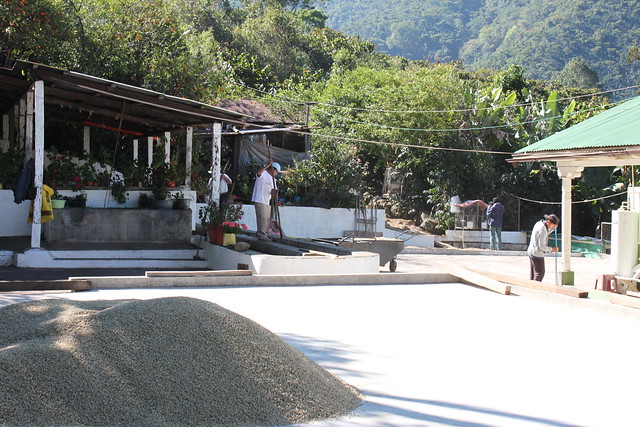
Work at the mill and patio at El Diamante
I had a few bags of our roast of El Diamante with me to give Patricía and show how we roast and present her coffee. Our label text is in Danish so I translated it to her. It was great to show her this and tell her that we very much liked her coffee and that we had many costumers who also value it very highly. When I told her that we had no more of her coffee in stock she laughed and said that then we had come to the right place.

The coffee we had last time from El Diamante had a flavour profile and especially an acidity that reminded me a bit of a gentle top Kenyan coffee. When visiting the mill again I was curious to see how much of this flavour might stem from their way of fermenting. So I tried to understand this in to more details. It turned out that they ferment up to 40 hours and after washing they do an overnight soaking around 12 hours (and even longer at sometimes) where the washed parchment is well covered with water. This seems not unlike what they do in Kenya and is at least not very typical for what I have seen in Guatemala.
I wonder about the fermentation processes during this soaking. I guess the temperature will still be around 15-20 C (at El Diamante they have a pond lying few meters above the mill from where they get their water. It is my impression that the water will be sitting here long enough to be at least 15-20 C). At this temperature fermentation will still be going on. The anaerobe environment when the parchment is covered with water also shouldn't stop fermentation. It would be interesting to know more about soaking influence on the flavour profile.
The next day we went to Finca Vista Hermosa. Here Drew was doing a great job on test roasting lots of samples for us to cup. We had the chance Wednesday to cup the samples we brought from El Diamante and to be honest - we where a bit disappointed. The beautiful fruitiness was tipped over towards over-fermentation. This was really sad to cup since we really enjoyed the coffee last year and even more we enjoy working with Patricia.
Drew agreed to do a re-roast of the samples and we cupped it again the day after. Luckily the different roast seemed to have tipped the coffee back on the right track but the experience from the first cupping still stuck a bit with me. Therefore we got more samples sent home and later when we where back in Denmark we roasted these samples again and here we had no trace of over-fermentation. The new crop El Diamante was again a beautiful fruity cup but entirely on the clean side.
I must admit that I havn't been fully aware of how much the roast can do in tipping a fruity coffee like this from one side to another on the border between fruitiness and over-fermentation. It’s of course a bit scary but on the other hand I feel comfortable that we in our production roasts can find the profiles that will bring out the best fruitiness in this coffee without any over-fermented tones.
- Peter Dupont
You can see all our pictures from the trip in this Flickr set.
